
As summary tools become more common at work, many teams are discovering a limitation: most summary tools still assume that shorter text means faster reading.
We know that isn’t true.
That’s why we’re introducing Summaries, a new feature in Read&Write for Work that takes a different approach - adapting information to how different readers understand information best.
Most generic summary tools don’t do this. They produce a single, fixed output, focused on shortening content rather than supporting real understanding.
We know that different minds need different ways into information. When summaries don’t adapt, it creates friction instead of clarity. Important details get lost, cognitive load increases, and work takes more effort than it should.
This update will change that.
Coming soon for Group and Enterprise subscriptions...
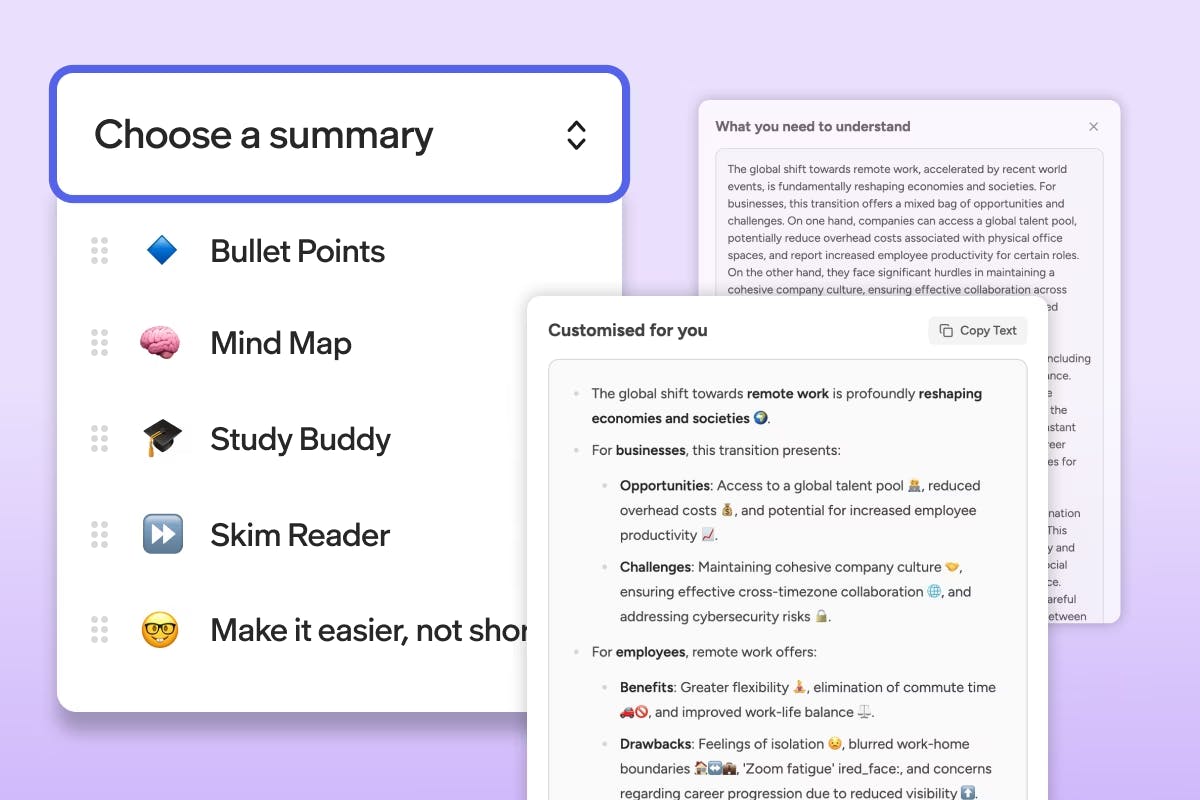
Summaries move beyond one-size-fits-all outputs to formats that support real understanding by letting people reshape information into formats that work for them.
Instead of a single fixed summary style, people can now choose how information is presented, including:
- Clear bullet-point summaries
- Skim-reader views that surface key information fast
- Easy read formats that reduce language complexity
- Mind-map style summaries that show structure and relationships
- Custom lens, allowing users to choose a format and refine output based on goals
The context stays the same, while the format adapts to the reader. Users can further personalize by choosing the level of detail they want to receive, as well as adding visual support with relevant emoji and an emphasis on keywords.
What does this mean?
This update reduces cognitive load and makes information easier to understand, act on, and remember.
For neurodivergent employees, it helps remove common barriers caused by dense text and rigid outputs. For example it:
- Reduces overwhelm and reading strain experienced by dyslexic users and more
- Makes it easy for users to find key points without navigating through walls of text, particular helpful for ADHD users
- Makes content more predictable through structured formats and custom lenses, helpful for autistic users who prefer consistency
At the same time, it benefits everyone. Instead of working around a one-size-fits-all output, Summaries gives users the flexibility to choose the format they need in the moment.
What early reviewers have told us
Summaries was designed through a neuroinclusive lens, by Everway’s dyslexic Founder and neurodiverse product development team. It has been piloted by our Early Access Feedback Group, and shaped according to early feedback.
Here’s what some of this group has shared:
“I have dyslexia, and it is challenging for me to both read and write.... It’s really great to be able to take a massive amount of text and summarize it into its key points… I find value in being able to set up custom lenses that make sense for the walls of text that I am reading.”

As well as supporting information processing, Summaries is also making it easier to communicate. Oliver Back explains.

What’s next?
For customers - share this news with your teams and get in touch for an exclusive sneak peek.
Not a customer? With Read&Write for Work, you can extend accessibility inside the tools people already use, bringing neuroinclusion into everyday communication.
Find out more about Read&Write - now included in the Everway for Work suite.